Monthly Archives: July 2016

Food Pantry at St. Gregory’s of Nyssa


July 15, 2016


My fingernails are orange and my hands stained with dirt from scooping handfuls of carrots into shopping bags for 300 people walking around the altar and gathering food for their physical needs at St. Gregory’s this afternoon. Sara, the one who started the food pantry 16 years ago, said that the sanctuary space is used for everything and about 700 people grace the sacred space each week. Elena and Benjamin likewise have stained fingers but in their case they scooped piles of Persian cucumbers into bags and wear the badge of green hands. We arrived at 8:30 to help set up and just jumped in and did whatever needed to be done—unpacking boxes of vegetables into a circle around the altar, breaking down boxes, moving crates, carting pallets away, and chatting with the other volunteers.


Rudy, an 86-year old Filipino immigrant, comes to help out every week and can be found sitting on the back patio sipping his coffee while breaking down boxes. Prior to jumping in, he attended the Morning Prayer service and greeted me with a kiss on the cheek and a warm smile. I sat on the patio for a while and broke down boxes while talking with him in his broken English about his life and then he kissed me on the cheek again when I took his photo. I wanted to ask if this was a Filipino custom, but I was not able to communicate with him very well in words, yet his kisses and kindness spoke volumes about his compassion and respect for a fellow volunteer. After we left, Benjamin said to me, “I really like Rudy. We talked.”


After all the initial set up was complete, the volunteers, somewhere in the ballpark of 25 or 30 people, sat down and shared a meal together prior to the guests arriving to pick up food. Kitchen volunteers show up each week to cook and serve a meal, which is for some the only cooked meal they will have that day. The first person we met was Edmund, who lives on the streets but comes faithfully every Friday at 8:00 AM to help set up and stays to the bitter end to help clean up. I noticed him talking with the dancing saints painted around the rotunda and asked him if he had a favorite. He said, “My favorite pair is Malcolm X right next to Queen Elizabeth I” and when I asked why he gave me a great history lesson about Queen Elizabeth I.


Before the guests arrived, the volunteers shopped for groceries and at first I was a little reluctant to participate because after all I could afford to go to the grocery store and buy food and most of the volunteers could do the same. As I watched them chat over the plums, roll melons around, and test the carrots and cucumbers by eating a few, something in me shifted from the privileged position of affording groceries to that of solidarity with all humanity that has a need for food to survive—it became not a privilege but a necessity and a way to connect with all humanity in that moment of hunger. I shopped for the few things that I thought we could eat in the next few days and had a great conversation with Rev. Paul over the size of the cucumbers and how they would make great fermented pickles. Food is my thing and despite not being in a grocery store or a restaurant or my own kitchen, I was in my element and I decided to embrace it.


My carrot station was set up right next to Elena and Benjamin’s cucumber station and we were sandwiched between Miranda on oranges and Valentina on apples. Miranda was fairly quiet and enjoyed watching Elena and Benjamin and commented on their funny antics and how they poked at each other. Valentina, an immigrant from Ukraine, was a bossy grandmotherly figure that kept a close eye on the kids and assertively told them how to do their job, which they dutifully listened to then turned away and had a good laugh with each other and looked at me as if to say, “Is she for real, mom?” She told me that I have very good kids and asked if I stayed at home with them and when I responded that I had for quite some time, she said, “That is why they are so good. It is because you were with them.”


Valentina told Benjamin that he could not play cards (he was practicing a magic trick) because it led to the road of darkness, and she told Elena that she could not lift anything heavier than 10 pounds because it would ruin her uterus and her babies would be born dead. We had a long talk in the car on the way home about the former Soviet Union’s ban on religion and the practice of religion in secret that led to the holding on of ancient traditions and superstitions and how we listened to and respected elders but that did not mean that we had to agree or follow advice. Elena bit her hand so hard to keep from laughing while Valentina spoke with her that she has bite marks that may need a week to heal. I have a feeling that Valentina will become fodder for tales of folklore in the Luna collection of family stories.   I have a photo of her with the kids and Rev. Paul photo bombing the picture, which, with his extreme tolerance, is quite an appropriate contrast to Valentina’s conservative/traditional messages. Both kids really enjoyed meeting Paul and Elena said, “Paul is nice, I’m glad we met him,” which is a huge compliment from the most discerning person I know.


Joe, a regular volunteer that kept on eye on all and refilled crates and broke down boxes as fast as we could empty them, came up to me three times and told me how hard my children worked and how impressed he was that they stuck with it for so long. I have to agree—I was quite proud of them as they did work hard, but they also interacted with the volunteers and guests and wove themselves into the fabric of the experience in colorful way that I did not expect. It is so nice when my children surprise me! At one point, Benjamin said, “I like this place, it’s nice. It’s fun to work here.” These simple words spoke volumes not about Benjamin but about the meticulous organization of the food panty and about the respect the volunteers meted out to Benjamin and Elena and their treatment of them as young adults capable of hard work.


Anthony, a young man that showed up to volunteer right before our lunch was talkative, funny, and entertained Benjamin with tricks and jokes. Susan, who speaks fluent Mandarin, was sitting at the table greeting guests as they arrived and since 90 percent of the guests are Chinese immigrants, mostly women, that don’t speak English, Susan is much appreciated and valuable volunteer. Valentina, and Elena, another Ukrainian volunteer (not my Elena), could be heard above the din speaking Ukrainian to the many Ukrainian immigrants that partially made up the other 10 percent of the guests along with white people, African Americans, and Latinos. Elena was one of the only other Elenas that we have ever met (the same name and spelling as my daughter) so I took their photo together, which pleased both Elenas.


As far as I could tell, Michael was the only employee of the Food Bank that was there to supervise our set up, implementation, and break down of the food pantry. The San Francisco Food Bank shows up every Friday morning with truckloads of fresh fruits and vegetables along with staples such as rice, beans, pasta, bread, and miscellaneous treats and drinks. There was very little left over when we ended at 3:00 PM. It was a very different experience from my volunteer work at my local food pantry, Valley Outreach, in Stillwater, which is a warehouse type building where clients shop much like they would in a grocery store. At St. Gregory’s the guests enter into Jesus’ home with a beautiful painting of him leading a dance above us while we feed each other and all this is done around the altar, that sacred space where Jesus feeds us the spiritual food of bread and wine. It was a holy experience, one that Elena, Benjamin and I will not forget.

Morning Walk…Random Thoughts

July 13, 2016

I stepped out of our tiny rented apartment this morning with dog, dog leash, and plastic poop bags, and thought, “Wow, another beautiful, sunny day.” Then I remembered that I’m in Berkeley and every day is the same except for those few short weeks between December and February when it can rain during the wintertime. When I first moved to Berkeley many years ago, this really bugged me—the sun was too bright and intense for me and I wanted it to tone itself down a bit, take a vacation from being so cheery and bright all the time. Having moved from Michigan, the land of severe weather shifts, I found the weather in Berkeley boring. Some people love this about living in the Bay Area—that they can count on the weather every day to be the same and maybe it does take one variable out of the equation of a busy lifestyle—what to wear and weather or not to carry an umbrella. I for one, will take a thunderstorm and some good lightening any day and am willing to carry around my umbrella just in case and am even more willing to let the rain fly and give me a bath.


A little boy of about 3 years was waiting on his porch and as his mom approached I heard him say, “Mama, you’re back, I’m waiting right her for you. You were gone a long time.” I had seen her walking their dog to the corner and back about two houses down, and what seemed like a bleep in time to me seemed like an eternity to this little boy yearning for his mother to come back home. I forget what famous scientist said that we can all have different experiences of time and when I heard that sweet little boy’s voice I thought, “I want to slow down time and know the yearning of something really good to come in the next few minutes or hours or days.” I know there have to be good things passing me by all the time because my “time” rushes by them before I can notice these treasures.


Dreamer and I walked through Strawberry Creek Park, an idyllic little place with playground equipment next to an historic building with a cute little café that had tables out on the brick patio awaiting the early morning coffee drinkers. When we approached the park we saw a dog named Pepper climb a 15-foot tree and sit in the branches before climbing back down! I didn’t know dogs could climb trees; it actually appeared that he was running up the tree, but even so, I didn’t know dogs could run up trees! His babysitter told me he was a sheepdog and that he was climbing his favorite tree and that he does it often. I saw a dog climb a tree!


Elena, Benjamin, Dreamer, and I have been driving around Berkeley to various restaurants and stores to explore and to wait for that unexpected adventure to happen. The kids noticed that I am constantly pointing out good restaurants. If you asked me to remember these restaurants I wouldn’t be able to tell you about them or where they are located, but as soon as I see a gem I immediately know I ate there and I can taste the Indian or Ethiopian or Thai or Mexican food that pleased my palate.


As I wander around the neighborhood we are staying in I snap photos of interesting things I see. It is a diverse neighborhood in many ways including ethnically and economically and some in Berkeley would be quick to add that it isn’t a good neighborhood. Berkeley is polarized and the wealthy people tend to live in the hills in fancier houses and the less wealthy people live in what are called the flat lands, but who gets to decide what is considered a good or bad neighborhood? When I lived in Berkeley I had a tiny rent-controlled apartment on the edge of campus on the edge of the hills. Aside from the people that also rented in the cut-up house turned apartments, none of the neighbors bothered to talk with me or get to know me. Is that a good neighborhood? Here, today, as I sit in a tiny rented apartment in the flat lands, it is clear that the neighbors know one another and look out for each other, people walk their dogs and stop to chat, children play in the parks, and people hurry off to work in the morning while greeting one another. It is true that there is more garbage on the streets and that a few blocks away there are homeless people pushing shopping carts, but as I wander around I learn that they are also part of the fabric of this diverse neighborhood. This feels like community, which to me is a good neighborhood!


I moved to Berkeley from Ann Arbor, Michigan, which isn’t a small town, but is a dwarf in comparison to Berkeley. I remember being excited by so much activity and the availability of anything you could imagine—every type of yoga imaginable, every ethnicity represented by a restaurant, great bookstores, markets with fresh local foods, farmer’s markets, non-profits that represented every imaginable cause, etc. Amidst this excitement was a hint of fear as I had never lived someplace so diverse and lively, which could sometimes paralyze me because I didn’t know where to go or what to do or if it would be safe. I think women spend a lot of time thinking about their safety and rightly so, but I wonder if fear sometimes held me back while I was living here in such a foreign environment. I wander around now and talk with people freely that I might not have talked with previously out of fear of how they might respond to me and I wonder, what other fears are holding me back from really living and experiencing a full life?


I’ve read some stuff by James Cone recently, an African American theologian, and am thinking a lot about race, and am challenged and enlightened by his work, so I’m sure some of my thoughts this morning about an adventure with Benjamin and Elena are influenced by my reading Cone. We went to Lois the Pie Queen for breakfast, which is located in an African American neighborhood in Oakland. It is the kind of place you can get fried chicken with eggs and grits for breakfast and have some pie for dessert. I loved this place when I lived here but didn’t go very often because I always felt I was being intrusive by inserting my white body into a sacred African American space. Of course, I am completely welcome there but I do wonder why I am so welcomed into a sacred space when my white brothers and sisters aren’t always so welcoming of difference in their sacred spaces. My children are completely unaware of any of these dynamics, or at least if they are, they don’t talk about it; which makes me think they aren’t aware because they talk about things like this with me. Their only comment was repeated by both of them, “I like this place!” The wait staff and cook were all Latina, the manager was African American, I was one of two white people, and my children were two of many bi-racial patrons among mostly African Americans. I pray that experiences like this will be a normal part of my children’s lives, that race will be a cause for celebration and curiosity not division, and that they embrace the adventure of knowing people from the inside out.


Money—the universal church concern

Sunday Services at St. Gregory of Nyssa

July 10, 2016

The morning Bible study group spent their time talking about a recent stewardship survey sent out by a hired consultant to assess the feasibility of running a capital campaign. The reason they focused on the survey is that the majority of the participants (4 out of 5) were offended by the survey questions and felt the need to discuss it with other members. Some of their concerns—an outside consultant was hired that doesn’t know the community, they did not know the mortgage was not paid off, they felt the questions were too personal about individual/family finances, it didn’t appear to consider volunteer work as a form of monetary support, it was asking for more than they could provide, and it was cold and impersonal.

Ah…money, the universal church concern, and the least talked about subject in any congregation. Why is that? Church is a community that resembles a family and I would assume that families have budgets that are discussed, modified, and available for review.

Our family has a monthly budget for variable household expenses (grocery, gas, music lessons, etc.) and one for fixed expenses (mortgage, water, electricity, etc.); the former I manage and the latter Ernesto manages. It is an open book in our house. Every two weeks I print a budget sheet that gives amounts of money available for various categories of household expenses and when the kids ask for something we refer to the budget to see if there is money available.

My Episcopal congregation is the most financially transparent and democratic faith community in which I’ve ever participated and I’m so appreciative of that, yet, like all congregations, it is not without its fair share of money concerns.

I told the Bible study group that stewardship is a really important aspect of church communities and necessary to discuss and be transparent about. Then I asked, “What process would have been more acceptable to you or in what format would you have liked to discuss the money issues of St. Gregory’s?” They were unprepared for my question and said they would need to think about it, which is fair.

It seems that so much of our church community budgets are tied to infrastructure, which makes me wonder if we need to reconsider where we meet and choose cheaper alternatives. No answers here, just more questions than I have time to explore.

A Place of Extremes


July 11, 2016

It is strange to be staying in Berkeley after not having been here for the last eight years. I recognize street names and there are familiar places but it is more crowded and noisy than I remember and the extremes that were always here are more palpable.

This morning I walked Dreamer along the Berkeley Aquatic Park, which is a narrow strip of greenway next to a narrow body of water, which might be part of the Bay, but it is hard to tell. Right next to the water is the freeway that takes you to the Bay Bridge into San Francisco with its gorgeous views of the Bay. There is something disconcerting about having a greenway next to a freeway, yet in a crowded city where every space is utilized, it is amazing there is a greenway at all.

I walked the same greenway with Dreamer and Ernesto the other day and my observation is that it is never silent here. There are always cars passing, the Amtrak and cargo trains run frequently, sirens blare, children scream, adults talk, dogs bark, ducks quack, and bicycles swoosh by—a constant cacophony of sound. For me, someone who thrives on silence, there is something agitating about it, but I can also recognize the beauty of it—hearing many languages spoken, joyful children, people using bikes instead of cars, the incredible diversity of people eking out a living in the same confined neighborhood.

I walked past a day camp on my walk and peeked in to see what they were doing. A staff member came out to talk with me about the paint explosion project they were working on and explained a little bit about their maker-camp that used power tools and other sophisticated processes to make creative projects. I also passed a Spanish-speaking day camp using a public park where the children were climbing on playground equipment and playing ball.

The greenway parking area is littered with RVs that I’m guessing people live in, right next to expensive cars like BMWs and Mercedes. A blind boy with his aide walks down the street as the aide teaches him how to use a cane. There is a waterfront nonprofit called Waterside Works that trains youth in job skills and includes a bicycle repair and rental shop, a café, and a wooden boat workshop for repair and sales. Right next door is an organization that builds bikes for those who cannot walk by creating hand-operated recumbent bikes. A group of people using these adapted bikes gathers on Saturdays and rides the trails along the waterfront.

On the corner are three homeless men pushing shopping carts with their belongings and two step away are two women out on their work break taking a walk and chatting (they had lanyards with IDs around their neck—a clear clue to employment).

I was on BART (Bay Area Rapid Transit) yesterday where I sat next to a Muslim woman dressed modestly and a scarf on her head, and right next to her was a young woman wearing as little clothing as possible in order to show us her artistically tattooed body with its many colors and designs.

If you don’t like to wait, this is probably not the place for you, because, despite the frenetic pace of life, there is constant waiting. I wait at the BART station for the train to arrive and then wait again for another train when I need to transfer at another station. I wait to look at the butter at the grocery store because there are so many people crowded around the dairy case. I wait for the cashier at the neighborhood store to stop talking about soccer so I can pay for my IZZY. I wait in traffic any time I drive anywhere.

It is ironic that such a busy place is filled with so much waiting, yet despite my normal impatience with waiting, I find myself welcoming the wait. I am relieved to sit down at the BART station while waiting for my next train because I’m exhausted and it gives me a little reprieve. I like waiting at the grocery store so I can watch all the people around me—I’m a real people watcher and sometimes worry that I’ll get in trouble for staring one of these days. Perhaps all this waiting is the only way people with such a frenetic lifestyle have to relax for a few minutes each day.

There is no space anywhere—every square inch of space is utilized for a building, a sidewalk, a school, church, something. The houses are inches apart and yards are the size of my front porch and this makes sense in an urban area and infill in incredibly environmentally sound. I wonder if waiting is a way to create space, at least mental space, where it is hard to experience a vastness of physical space.


First Service at St. Gregory’s of Nyssa

July 10, 2016

I woke early this morning and Ernesto and the kids drove me to Potrero Hill in San Francisco where St. Gregory’s of Nyssa is located, because the BART trains do not run that early in the morning. I arrived at 8:00 for the daybreak service of prayer, meditation and psalms, then went to the 8:30 Holy Eucharist contemplative service, talked with people during coffee hour, attended a discussion about stewardship, then attended the 10:45 Holy Eucharist sung service, sat with Paul Fromberg for his “Fifteen Good Minutes” question and answer session, then talked some more, helped clean up after coffee hour, and then was dropped off at the library by a friendly member named Cathleen.

This is what I saw. The first thing that stood out as I walked into the building was the vibrant paintings of the Dancing Saints, painted by Mark Dukes—90 ancient and contemporary saints and every saint in between. They include Julian of Norwich, Saint Gregory of Nyssa, Iqbal Masih (who spoke out against child labor), Thurgood Marshall, Li Tim Oi (first woman priest in the Anglican Communion), Black Elk, Cesar Chavez, Anne Frank, Thomas Aquinas, Ella Fitzgerald, and Isaiah. The Dancing Saints cover the eight walls of the rotunda where Holy Eucharist is celebrated, watching over the communion of all saints gathered for a sacred meal.

At the 8:30 service I noticed the many children that gathered in the seated area to hear the Scripture readings. The children were free to move about, allowing their curiosity to guide them to books and a finger labyrinth and other prayerful objects that they fiddled with, shared with each other, or just pondered. They talked freely with one another and with adults they knew, but their friendly banter was a welcome addition to the quiet and contemplative environment; I did not find them to be a distraction at all, and as a matter of fact found myself drawn to their freedom of movement, lack of fear about the appropriateness of talking and interacting, and their joy at sharing the space with other children they knew and freely hugged.

Both the 8:30 and 10:45 services were completely sung by the presider, the congregation, and at the later service by the choir. It was beautiful and contemplative and engaged so many important ways of expression—singing, dancing, thinking, meditating, sitting, and standing. I want to know more. I met Marissa, a PhD. Musicology student from Yale, whom I want to talk with to learn more about the use of music during liturgy.

The worship space is a large open room with chairs on one end where the word is celebrated and at the other end an altar in the middle of the rotunda with no chairs where participants stand around the altar to celebrate Holy Eucharist. While moving to the altar members dance together around the altar and are encouraged to stand close to the bread and wine. At the 8:30 service, children played the drums and tambourines while dancing to the altar, two children carried the chalices around during communion, and a younger child climbed under the altar to retrieve a musical instrument.

This evening I will attend the once-monthly 5:00 PM supper service organized and run by the youth of St. Gregory’s.

More later…

Road Trip Fun Facts

July 8, 2016

We made it to Berkeley this evening, tired but happy. Here are some fun facts from our road trip.

Itinerary

  • Breezy Point, Minnesota—picked up Elena (June 24)
  • Mandan, North Dakota (Bismarck)—hotel overnight (June 24)
  • Shelby, Montana—hotel overnight (June 25)
  • Glacier National Park—camped 3 nights (June 26, 27, 28)
  • Belgrade, Montana (Bozeman)—hotel 2 nights to regroup (June 29,30)
  • Yellowstone and Grand Tetons—camped 3 nights (July 1, 2, 3)
  • Boise, Idaho—hotel overnight (July 4)
  • Bend, Oregon—hotel overnight (July 5)
  • Crescent City, California—camped two nights with Ernesto’s sister and family (July 6-7)
  • Berkeley, California—10 days (July 8 – 19)


States traveled: 7

Minnesota

North Dakota

Montana

Wyoming

Idaho

Oregon

California


National Parks Visited: 6

Glacier National Park

Yellowstone National Park

Grand Teton National Park

Craters of the Moon National Monument

Crater Lake National Park

Redwoods National Park


Big Cities we Visited/Passed Through

Bismarck and Mandan, North Dakota

Belgrade and Bozeman, Montana

Boise, Idaho

Bend, Oregon


Small Towns we Passed Through

Hundreds and Hundreds


Favorite Places Visited

  • Atomic Energy Museum—it was so bizarre, in the middle of nowhere and just like you’d expect is that there was a nuclear facility. I wished we had stopped to get an atomic burger and pickles. (Ernesto)
  • Glacier—it was astounding and I liked the Ranger Programs, they belonged to the part and they were sharing it with you. They loved the park and were sharing it with us and that came across. (Ernesto)
  • Yellowstone—it was strikingly beautiful even though it was crowded, the landscape overcame that. (Ernesto)
  • Two Medicine at Glacier NP—I liked learning about the history and Native American culture and it was beautiful (Julie
  • The Redwoods (Julie)


Favorite Restaurant

The Roost in Bozeman, Montana—all my sides had bacon in them, yummm! (Julie)

The Roost—I like fried chicken and the cole slaw was good and Dreamer got to sit with us (Ernesto)

The Roost—it was good (Benjamin)

I don’t know (Elena)


Miles Traveled

We forgot to track them but we guess about….3050 miles so far


Gas Stations and Restrooms

Too many to count


Parks Dreamer Ran in and Dogs Sniffed

Too many to count but Hines Park in Hines, Oregon was a favorite because of the sprinklers (Dreamer and Benjamin) and the vintage playground equipment (Julie and Elena)


Movies Watched

Letter to Juliette (Elena and Julie)

Dirty Dancing (Elena and Julie)

Bourne Identity

Inception

Lots more…


Books Listened To

Benjamin and I finished listening to a trilogy that we started in early June when we took a road trip to visit family, but for the life of me, I can’t remember the name. I’ll post it later if I can remember it.


Knitting Accomplished

1½ skeins of yarn on my shawl—Rowan felted wool yarn and that really easy shawl pattern that is a rectangle that is folded in half. See above about not remembering things. I’ll post it if I can find the pattern in my jumble of stuff.


Interesting Billboards

Follow Me (God)

Famous One Log House

The Legend of Bigfoot

Confusion Hill 1 mile

Chili Cook Off and Dance

Pour Girls Coffee House

Don’t Forget the Magic!

Mr. Fish Seafood

The Human Brain Continues Growing Until Age 25

Plant Something—Roots Organics

You Just Missed It!—The Skunk Train

Purple Moose Thrift


Junk Food Eaten

At least 10 of potato chips

1 box of gummy Jolly Ranchers

1 box of Milk Duds

1 bag wintergreen Lifesavers

1 bag peppermint Lifesavers

25 or more s’mores

Driving down the Coast of California

July 8, 2016

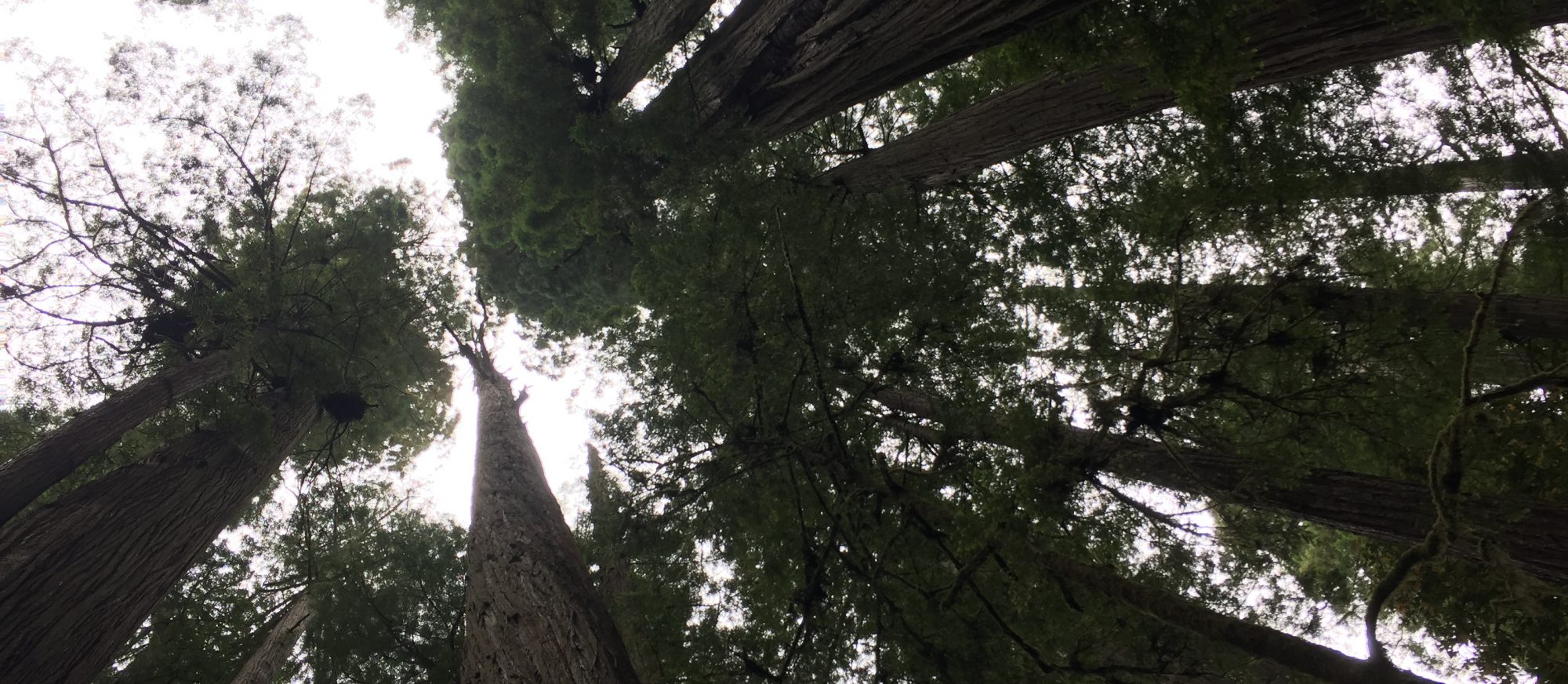
We left Crescent City this morning where we were camping with Ernesto’s sister, Elva, and her family and now are driving down Highway 101 on the coast heading for Berkeley, California where we will stay as a family for the next 10 days. While in the most northern part of California, we visited the Redwoods State and National Park and marveled at the enormous redwood trees, which are each an ecosystem unto themselves—they are truly majestic. We also spent an afternoon at the ocean, the first time we’ve been to our beloved Pacific Ocean since last in CA 3+ years ago, and we were all giddy with joy, running up and down the beach chasing Dreamer and combing the beach for treasures.

We’re stopped in Eureka, CA, not a huge town, but they have a nice co-op where we just got sandwiches, humus, carrots, potato chips, a cup of clam chowder soup and a loaf of sourdough bread, the thing Ernesto misses most about living in California.

Eureka is not a huge town, but homelessness is extremely apparent here. A woman across the street at the bus stop with her suitcase, smoking a cigarette and wringing her hands through her hair; a man walking in his pajamas pushing a shopping cart, and several other lone soles looking for food. I was surprised to see security guards at the co-op and that I needed a code to get into the co-op bathroom, but Ernesto’s hypothesis is that they were trying to keep the homeless from cleaning themselves in the bathroom and from taking food from the co-op. I wonder how much money the co-op spends a year on hiring security guards and if that money could be better spent creating a community program to feed the hungry.

Just by observation, I’d say there is more homelessness in California than in Minnesota, but I’m sure it is also a function of population with CA being way more populated than Minnesota. I wonder if it is also a function of the weather—some more temperate places in California allow people to be outdoors most of the year whereas in Minnesota, it is not an option to be outside in the winter. What will it take for us to feed the hungry, clothe the naked, and give shelter to the homeless? What is wrong with us that we live in such a rich and abundant nation and people need so much that we are not able to provide?

It was raining steadily when we woke in our tents this morning, so we quick packed up, draped the wet tents over the load in the back of the car then Elva cooked us a hot breakfast before we got on the road. I expected it to clear up as we drove south along the coast, and the rain has subsided, but it’s cool, and mysterious as the fog rolls in over the craggy coast and coats the land with impenetrable mist. It is beautiful in its own gray and cloudy way and reminds me how powerful the ocean is to create its own weather patterns.

The coast alternates between craggy cliffs and long sandy beaches and weaves inland through the foothills and back toward the coast as the land allows the road to travel through it. We are driving through The Avenue of the Giants in Humboldt Redwoods State Park where there is grove after grove of giant redwoods for 31 miles.   Redwoods only grow along the coast because they need the coastal mist as their primary source of moisture and their shallow root systems are adapted to the rocky land. It is like driving through an enchanted forest or something you’d see in a Star Wars movie akin to Endor, but only more fantastic. (Ernesto says: “They don’t look real, they look like a figment of George Lucas’ imagination.) To make it all the more fantastical, ferns, with their prehistoric look, are one of the only plants that will grow on the redwood forest floor because they like the moist environment created by the dark canopy that doesn’t allow sunlight through. The other very prevalent plant is poison oak that winds its way up the huge trunks blanketing the bark with triads of oak-shaped leaves. It is a symbiotic ecosystem that has been evolving for thousands of years.

It is all amazing—the ocean, the cliff, the sandy beaches, the giant redwoods, the ferns, and the coastal mist—we are blessed with an abundantly creative Creator! And God saw that it was good.

Traveling across Idaho

July 4, 2016


Animal sightings since Stillwater:

Buffalo

Grizzly bear and cub

Mountain goat

Big horn sheep (wandering the campground)

Osprey

Some type of hawk

Moose

Elk

Mule deer

Ground squirrels

Marmot

Yellow finch

Plover


Independence Day and we left the Grand Tetons this morning and are now driving across Idaho heading toward Craters of the Moon National Monument and Preserve. Although I admit missing out on the 4th of July parade and I have a hankering to see some fireworks, Independence Day is kind of a funny thought when this country already belonged to many nations prior to the arrival of Europeans. It is not their Independence Day but only sealed the fate of whole cultures being moved from their lands to inhabit less abundant and sometimes hostile land. Living in a mostly urban area, I’m not very exposed to Native American culture or presence, but driving through the northern parts of Minnesota, North Dakota, Montana, Wyoming, and now Idaho, the Native American presence is palpable.


Driving across Idaho is much like driving across northern Montana—flat, scrubby land, but much more dry and desert-like than the plains of Montana. Because there is nothing out here, the Idaho National Laboratory (INL) is headquartered here and is home to nuclear fuel research, training the military on radiation emergencies, and the mitigation of radiation fallout. Our curiosity got the best of us—we just couldn’t resist, so we stopped at the EBR-1 Atomic Museum, home of the first nuclear reactor in the United States—the first one that is to create a sustainable source of energy (it is run by INL).   Learning about the science and mechanics of producing nuclear fuel was fascinating and the museum was filled with propaganda about the merits of nuclear energy—all stuff on which a Hollywood conspiracy movie would thrive.


Just left Craters of the Moon National Monument and Preserve and it was really, really cool—forget what I said about Yellowstone being otherworldly, this place is truly otherworldly! The lava looks like a giant paint brush used thick oil paints of greys and blacks with hints of reds, yellows, and oranges, to form textures and swirls and chunks of paint that cover a canvas for miles and miles. The best part is that the artist came back and splattered the canvas with wild flowers and crazy, twisted trees that use the wind to shape themselves into skeletons looking out over the craters. Craters of the Moon was formed by the Great Rift volcanic rift zone shifting and causing crustal fractures that spewed lava from volcanic cones, starting about 12,000 years ago with the latest eruption 2000 years ago, it is a vast expanse of every type of lava flow. Benjamin and I hiked through two caves formed by the cooling of lava tubes, one of which formed a tunnel over 800 feet long, where the Shoshone nation build circled rock formations, which they used along with the tunnel for sacred ceremonies.


It is amazing how diverse the U.S. is—we are driving through scrub foothills on our north and lava flow fields on our south. Photos are posted on Instagram and Facebook.


At one of our bathroom stops, a little gas station in a little town in Idaho, which I can not remember the name of, there was a one person family bathroom for everyone to use. As expected, there was a line up of 8 to 10 people impatiently waiting to empty their bladders after long drives across the Idaho desert, and of course, the restroom was occupied. As we waited and waited for upwards of 10 minutes or so and no one materialized from the little bath, the boy of about 8 years old standing behind me asked me, “She is taking a long time, what do you think she is doing in there?” I simply said, “Yes, she is taking a long time isn’t she?” After I used the bathroom, the little astute boy said to me as I was exiting, “That was much faster!” Kids are great!


Just stopped in a sweet little town, Shoshone, Idaho, which is the county seat of Jackson County, Idaho. We went into the local Sinclair (big green dinosaur) gas station to get cold drinks and use the restroom and discovered that it is thriving little Mexican market run by two bi-lingual Mexican women who talked with Ernesto alternating English and Spanish, and we bought local tortilla chips and jalapeno potato chips (I needed something salty and what is better on a road trip than a bag of chips!). I am always surprised to see Mexican families out in the middle of nowhere and Ernesto always tells me, “Julie, there are Mexicans everywhere!” And not just are they everywhere, they are industrious, hard-working entrepreneurs.   I heard a recent story on NPR about how Latino families are revitalizing small towns across American by moving in and starting downtown businesses and filling the schools with hard-working children. It will be interesting to see if they stay or if they will follow the pattern of white flight to the cities as the children grow and attend college or get jobs elsewhere.


Oh, this was the best part—there was a pretty little Episcopal Church called Christ Episcopal established in 1889 right across the street from the county seat courthouse. Every small town we’ve driven through has had a JCLDS church, which is to be expected, so I was pleasantly surprised to see an Episcopal Church. Dreamer spent time chasing a stick on the lawn of the county courthouse, and as we were leaving town I saw a universal sight—two boys, eight years old or so sitting cross-legged on the sidewalk both staring into devices while rapidly moving their thumbs!


We’re spending the night in Boise then heading to Crater Lake tomorrow…

Yellowstone and Grand Tetons

July 1-4, 2016


We arrived at Yellowstone yesterday and drove right through to the Lizard Creek campground in Grand Tetons about 12 miles south of Yellowstone. We’re not big on crowds, so we figured we could camp in the less-crowded Tetons and do a day trip to Yellowstone. Seems kind of sad to do a day trip to Yellowstone, but we are trekking across the country to get to Berkeley, CA on July 8, when Ernesto needs to go back to work and I start my internship at St. Gregory’s of Nyssa in San Francisco.


A day trip to Yellowstone had us visiting a variety of spots to get a sense of the multifaceted geology of the park—Old Faithful; Midway Geyser Basin and Prismatic Pool; Artist’s Paintpot; Grand Canyon of the Yellowstone, Hayden Valley; Yellowstone Lake; and the Grant Village Post Office to mail some postcards. The geysers are hauntingly beautiful and otherworldly and the canyon area was spectacular and intriguing. Great day!


Yesterday, we did a day trip in the Grand Tetons, which are huge, spectacular and much higher (10,000 to 13,000 feet) than I anticipated. Again, we visited a variety of spots to get a feel for the place—the mountains; Jackson Lake; remote roads with wildlife; Mormon Row, an historic settlement—ending with a tram ride up to a 10,450 foot peak, the name of which I don’t remember at the moment.


As we were leaving the part on July 4th, we stopped at the two Teton Park Chapels—Chapel of the Sacred Heart, a mission of the Catholic diocese of Cheyenne; and the Chapel of the Transfiguration, a remote site of the Episcopal Church of Jackson Hole, Wyoming. They were both beautiful, but I was really taken with the huge window behind the altar of the Transfiguration Chapel overlooking the Teton Mountains—what a great way to celebrate the Creator and creation!!


Photos are posted on instagram (jujuannlulu) and facebook


Vacation Pit Stop

June 29th, 2016


I’m not sure what the date is—Ernesto tells me it is June 29th. We left Glacier this morning and made a pit stop in Great Falls to have our car checked out because it was making funny clunking noises while driving through the mountains. Luckily it was just the tires, which had large chunks taken out of them, and we knew we would need to replace the tires at some point in the near future, but discerned they were safe for travel. We were wrong. We spent the day wandering around a city park and eating gourmet, local and organic salads and Montana beef burgers at Bert and Ernie’s restaurant, which was quite good. It is nice to not be on a schedule and take time to do ordinary things like hang out in a park while getting new tires put on the car. We met a man with a macaw on his wrist that stopped and talked to us for quite a while about his bird, which talked and laughed. Everyone has been quite nice and very friendly.


Before leaving for Great Falls, we decided to stay put in Two Medicine, Grand Tetons, while camped because we didn’t trust the car. Normally we would drive around and hike in several locations to take in as much as we can, but there was something quite relaxing and special about being in one place and really getting to know it and studying it and going to the same spots over and over again. I enjoyed it.


The kids, when we are not doing something active, complain about being bored. I remember being bored when I was a kid and my mom telling me that she wished she were bored. I tell my kids that boredom breeds creativity and that they will soon find something interesting to do, which they always do. Benjamin is great at making up games to entertain himself. The other day he spent a half hour playing hide and seek with Dreamer and then he made up rock throwing games at the lake. I love watching him play because he is so creative and such a free spirit!


Two Medicine, the area we stayed in in Glacier, was at one time home to the Blackfeet Nation, which now lives on a reservation on marginal land just outside Glacier. Two Medicine is named such because of two respected elder women from different tribes that picked out locations for medicine lodges on opposite sides of the river. Thus Two Medicine is named for two sacred Blackfeet locations in Glacier, which were taken away when the Blackfeet were removed from their lands. This saddens me and it felt disrespectful having white people instruct me about Blackfeet lands and legends knowing full well that the reason the Blackfeet were not doing it was because they no longer inhabit their own land.


We are now in a hotel just outside of Bozeman to regroup, take showers, do some laundry, and figure out our next adventure. We will eventually make our way to Yellowstone and the Grand Tetons, but in the meantime, we will relax, repack the car, empty out the cooler, and get a good cup of coffee. It feels strange to be indoors after camping the last few days when we spent nearly 100% of our time outside or in a tent. I get used to the feel of the sun on my face and the natural light and the rhythm of the sun and the breeze through my hair and the beauty of the landscape being so present everywhere I turn. Creation is glorious!


We are learning about Montana kind, which is akin to Minnesota nice, but different. OK, take this with a grain of salt, because I am not from Minnesota, I cannot fully understand Minnesota nice, but sometimes it seems like a euphemism for Minnesota passive-aggressive. Confession: I can’t really figure out Minnesota nice. Montana kind on the other hand was very palpable and contagious as everyone we met was truly kind and went out of their way to talk to us, often for long stretches of time, like Randy at the local grocery store who related his travels all over Mexico to Ernesto when he learned that Ernesto’s parents were from Mexico. Or the women at the thrift store who went out of their way to determine if I could use a particular coupon and the man who waited patiently while they figured it out. Everyone took time to talk and ask questions and tell us about themselves and their town; I wonder what it would be like to take time to truly listen and be present to anyone I encountered. Is it a function of living in an urban area that gives me the permission to be too busy to care about kindness to the stranger?


The following reflection about hiking in Two Medicine was written by one of my family members that wishes to remain anonymous, but it is beautiful and I want to share it.


You know when you’re out rock climbing or hiking and your guide tells you to not look down or you’ll fall? Well what if there was another reason they told you that?

I climbed one of the mountains in Two Medicine; not far up, but high enough that when I turned around to finally look down, it was breathtaking. Just standing there I could see for miles and miles. Anyway, what if the reason you were told to not look down/back is that if you do, and you see how far you’ve come, you won’t want to keep going because the view from where your standing is so amazing that you don’t think that the view a little higher up might be more spectacular than the one in front of you?

When I was standing looking down from the mountains, I almost forgot that there was another two thirds of the mountain behind me, what if that’s what your guide means?

Maybe that’s all that you’re supposed to gather from that, but what if you can apply that same principle to life? What if when you stop and look back at all that you’ve accomplished in your lifetime, you won’t want to keep moving forward, because you’re afraid that you’ll spoil the picture that you’ve created so far, instead of adding to it. I don’t know, maybe I’m just crazy. (By an anonymous Luna)