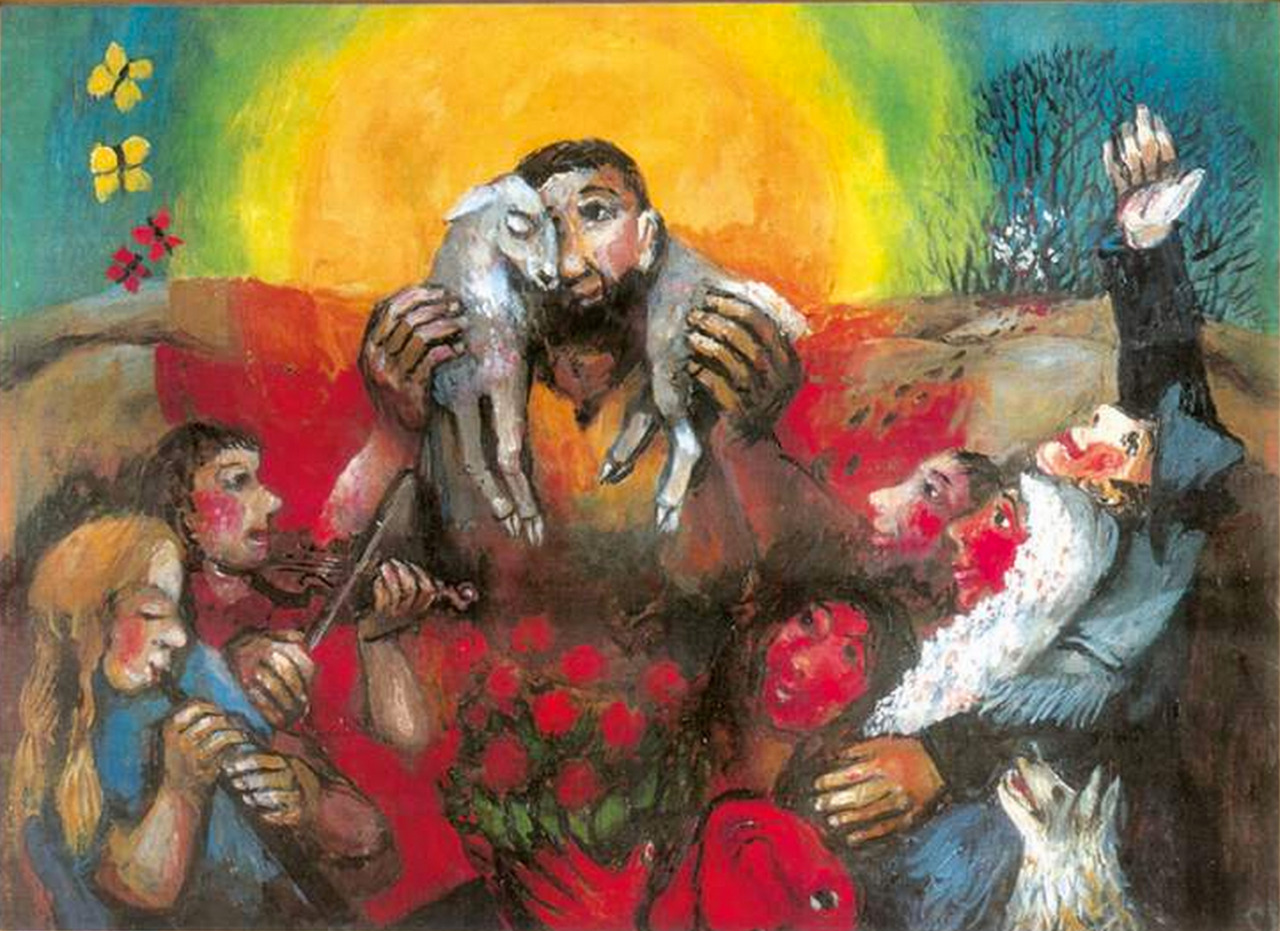
Save your Sheep

It’s been a minute and a ton has happened since I’ve felt the need to write.  Or more aptly, I’ve been too distracted by life to make writing a priority.

For six years, I had a crazy-busy job as a Priest working with Spanish speaking immigrants.  It was rewarding, challenging, joyful, and exhausting.  I left a year ago, and I’m still recovering my energy.

In the meantime, I’ve rekindled my artist spirit by creating my own art and work with faith communities to create art.  It is very life giving.

In contrast, my mind, body, and spirit are reeling from what is going on in this country and in the world.  As a believer in a benevolent and loving God, I refuse to accept the blatant hatred and vitriol being tossed about so carelessly.  What has happened to basic human decency and love for our neighbors?

Those who claim to be Christian and talk about, “Beating the hell,” out of people that disagree with them, is heresy.    And silencing one’s freedom of speech, when they disagree with what was said, is unconstitutional.  And firing someone for not pursuing a legal case because there are no grounds for pursing the case is illegal.  And taking away a person’s choice about vaccines is inhumane (if parents want to vaccinate their child who is to tell them they can’t?).

What is going on??? 

I try to hope in MLK, Jr’s arc of justice, and try to take the long view, but some days, I sit in despair and wonder if the damage we are inflicting on each other is irreversible in my lifetime.

We’ve made so much progress caring for the vulnerable as Jesus asks us to do. 
We had safety net programs, high employment levels, low inflation, medical coverage for more people than ever, and women’s health coverage that included abortion.  That is all being stripped away, leaving the vulnerable even more vulnerable.  How can these people claim to be followers of Jesus?

God, I pray for these lost souls, that are not working to restore your flock.  Gather them in like the lost sheep they are and give them soft hearts to do what is right and good to build your Kingdom here on earth.  Give them eyes to see you through the most vulnerable, ears to hear the need to care for the least of these, and hearts to love others the way you do.  Amen.

Sieger Koder, Good Shepherd.

Artwork—https://i2.wp.com/famvin.org/en/files/2019/05/sieger-Koder-good-shepherd.jpg?ssl=1

The Movie ‘Wit’ and Pastoral Care

We recently watched a movie called Wit in my pastoral care context. It is about a woman, Vivian, with terminal cancer and about the care she receives. It is told from her perspective and depicts her last months of life as she goes through treatment, grapples with forgiveness and loneliness, and reflects on the meaning of life and death. Ah…THE MOVIE…what am emotional experience that sheds light on the medical system and how it treats symptoms and collects research rather than healing the patient (healing…not curing, necessarily). The beauty of it is that it was written and acted in such a way that I could see myself in all the characters. I often enter a room thinking “I need to complete this spiritual profile” rather than thinking “I wonder how pastoral care fits into this person’s life.” In that way, am I any different than the doctor collecting research when I am collecting spiritual profiles? The place where I do find that I can be present and meet pastoral care needs as they arise is the 3rd floor. And, I’ve definitely been in Vivian’s place where I needed help and didn’t want to ask for it and finally gave in to realize that people are out there that would like to help me. I can’t say that I’m as isolated as she was, but I do often wonder about the isolation of illness and how boring it might be to sit in an unfamiliar place for days on end. And the nurse—she seemed to epitomize the conflict between the sterility of medical care and the comfort (hopefully) of pastoral care. She knew she was there to perform medical duties but she was also the one that talked with Virginia about end of life decisions and she advocated for Virginia when the Resident tried to revive her after she had died.   My favorite scene was the mentor come back to comfort Virginia and her reading The Runaway Bunny. She commented, about the book, “Look here, so many times God is calling us home.” Wow! I was struck by the juxtaposition of the whimsical drawings in the book and the serious message that God calls us home. But, like the book, we are children (God’s children) and God is constantly calling us home—calling us to return to God. What is I used that fact to guide my pastoral care? That is something I can think about for the rest of my lifetime!

another movie and pastoral care


Short Term 12

OK, so I watched a Netflix movie last night called Short Term 12, which was really interesting but got me to thinking about a lot of pastoral care issues. My myopic focus these days is relating everything to pastoral care ever since I started this CPE internship. I walk around asking myself, “If I were engaging in pastoral care, what would I do in that situation?” “Am I creating an unhealthy triangle with the other two people?” “Am I being empathic or am I crossing a boundary?” Excessive, isn’t it?


But (OK, I can’t let it go) when I saw Short Term 12, which is an excellent movie, with the feel of a documentary, about the staff and residents of a short term care facility for youth with challenging family situations, I kept asking myself that last question—is it empathy or is it crossing a boundary? The staff, most of whom grew up in challenging family situations and bear the scars of their childhoods, care for the youth with a loving yet firm disciplinary style.   At the same time they are empathetic, the staff also creates family-like bonds with they youth by sharing their stories and giving appropriate affection.


In one scene, a staff member shows her cutting scars to a young woman who is also cutting, which can be a way of avoiding emotional pain by focusing on the wound rather than what is causing the pain—it is often a “safe” way for youth to express their emotions while at the same time not having to confront an abuser. In this situation, and granted it was a movie, this was an effective way for the staff member to get the youth to open up and share her pain. Despite being a movie, it does beg the question—how much does a pastoral care giver share?


In the pastoral care setting in which I currently work, we are asked to maintain a personal boundary between ourselves and residents and are encouraged to listen empathetically but not share our stories because this may be a distraction from the resident’s story. The contexts are different—youth versus adults—yet many of the characteristics were the same—long-term residents and short-term residents, people with extreme need for care, people dealing with physical and mental trauma. So, I’m not completely off base when comparing the situations, yet the type of care provided was so different. I wonder if this is typical in short term care facilities for youth or if they just made it up for the movie.


In another scene of the movie, we see two staff member accompany a youth to the hospital and wait while he is being treated. It seemed so natural for this to happen and didn’t seem to cross a boundary. In a similar situation, I volunteered to accompany a staff intern, from my CPE setting, to a clinic because she passed out. She chose a clinic rather than a hospital because she did not have adequate health care coverage. After making sure this adventure would not interfere with my care and my family’s care, I decided that I wanted to take her to the clinic where we sat for several hours talking about her life and her dreams for her career. Later, I was talked to by my supervisor who strongly suggested that I crossed a boundary by taking away the agency of the staff member to figure out how to care for herself. I was aghast! In the moment of confronted with taking her to the clinic all I asked myself was, “If this was my daughter, would I want someone like me to take her to the clinic?” My answer was a resounding, “Yes, of course.” That was the question that guided my decision. It felt like the most loving thing to do, and by engaging in the situation, I learned a whole lot about this person and we bonded. But it does beg the questions—what is empathy and when does empathy cross a boundary when it becomes physical action or when can empathy involve sharing one’s story?


Watching the movie, regardless of how real life it was, did ask me to reflect on these questions about empathy and care. I was also drawn to reflecting on Jesus’ care for the other/stranger/foreigner/vulnerable that I learn from Scripture. Jesus was engaged. I just read the story of Jesus at the well with the Samaritan woman and was struck by how Jesus did not maintain cultural boundaries but broke every one—he talked to a woman, AND he talked to a Samaritan, which were both forbidden in his culture. Given the choice again, I’d still choose to take the staff intern to the hospital and to sit with her like I did until her boyfriend showed up to care for her. It was the right thing to do—it was a good boundary to cross.

Movies and Pastoral Care

Movies and Pastoral Care


I’m trying to catch up on watching some of the movies from the past year that I wanted to see but didn’t have time to get myself to the movie theater. I did manage to see La La Land on the big screen, which I’m so happy about because all that singing and dancing needed the expansive space to do it justice. Last night I saw, on my little computer screen, Manchester by the Sea. Wow! Interesting film. I love seeing parallels in movies between what is going on with the characters and relating that to other situations I encounter like pastoral care, family dynamics, scripture readings, or current social issues. Manchester by the Sea is rife with real issues—the characters deal with addiction, family dysfunction, denial, tragedy, forgiveness, or lack or forgiveness, unconditional love, emotional growth, decision making, death, obligation versus willingness, and acceptance.


It is not a movie with a Hollywood ending. Some might call it a sad ending, but I’d call it a wise ending—one that requires me to ponder the decisions made and if they were the most loving for all involved parties. It has an ending that is lacking in many movies today—it depicts real life. Many of the issues I listed above are ones that I encounter in my pastoral care settings. As I watched the movie, I found myself imagining how I might interact with the characters, especially one of whom seemed hopeless. How does one, as a pastoral care giver (or any caring person) deal with hopelessness? Do we accept someone’s desire to be hopeless knowing that we cannot change that person? Why is it that we want happy endings when we know that life is rarely a series of neat, tidy endings, but a series of hopefully wise decisions that involves considering how to best love everyone involved? I know that God never gives up on us, but how do I convey that to the hopeless? Prayer, prayer, prayer is the only thing coming to mind at the moment…

Cara’s Cabin

Cara’s Cabin


I’m on retreat. In my twenties, I always found that a funny word—retreat—and didn’t really understand what it meant. Now I get it!  Sometimes I want to run away—to retreat from my life.  This time, I’m retreating from the everyday demands of my time—studying incessantly, driving children around for hours at a time, caring for dying residents at my pastoral care internship (CPE), cooking, technology, the cats wanting constant attention, and all those other little things that seem to eat up endless amounts of time. As I type this list, I realize that my life is really pretty good and that anyone in their right mind would love to have a life like mine—full of love and friendship, happy kids and joyful animals, the chance to be in school. I think what I’m really retreating from is death. Ironic, huh, because it is something we can not escape from—we are in a constant state of dying the moment we are born. So what is it that I am REALLY retreating from? Maybe I’m really fleeing from something else.


Maybe I’m retreating from the emotional energy it requires to nurture others. I’m a nurturer—I like taking care of people. As a matter of fact Dreamer is staring at me right now because she wants to go out for a walk and I want to take care of her. I feel guilty because I am not walking her. Guilt. Such a strange emotion. I think it has become such a part of my fabric that I wouldn’t know what it felt like if it bit me in the nose. Guilt—this is another huge topic for another time.


I take care of others so I need to retreat to relearn how to take care of myself. Focus on my needs and relearn how to take care of them. I’m at a friend’s cabin. This is not a fancy retreat that I paid for. Except for the groceries I bought, this is a free retreat in a little cabin in the woods on a lake. Cara lets me use it when it is available—she is incredibly generous with sharing her cabin. The cabin is small but the perfect size and it feels like I’m sitting in someone’s cozy, well-decorated living room. Cara has put care into arranging the furniture and the soothing colors and the comfy pillows. I feel cared for by the cabin—if that is possible—when I’m here. Some invisible person (not so invisible because it is really Cara behind all this) has taken great strides to make sure I’m comfortable and well cared for. I am reminded of the hospitality that is emphasized in scripture—the angels of God visiting Abraham and his care of the stranger, and Martha welcoming Jesus (John’s gospel) and waiting on him (Luke’s gospel). Hospitality is a lost art in our culture.


Don’t get me wrong; no one is here waiting on me. It’s just me and Dreamer. I cook my meals, take long walks, sit and look at the lake, knit, read books, and generally learn how to listen to myself calling myself in each moment—Julie, this is what you feel like doing right now. No demands other than that still small voice of the Holy Spirit screaming hard to be heard over the demands of my time that rattle around in my head. When there is no one else around, I begin to listen to myself again. To really listen to what the Holy Spirit is calling me to do. Now, the real trick is—how do I do that once I get home again?   I am comforted knowing that I am learning and I can retreat again and again as many times as I need until I’ve figured it out. Thanks be to God!


Dog Park and Exegesis


I went to the dog park this morning to do my assigned dislocated exegesis exercise. I picked this spot, not because I gave it a lot of thought but because I knew there would be people there, which fulfilled the basic requirement of the exegesis, and I really needed to walk my dog, so I thought I could kill two birds with one stone. I’m not very chatty in the morning, except with my family when we eat breakfast together and talk about random teenage stuff, so going to the dog park in the morning was a stretch for me, but I justified it by knowing this was outside of my normal study sphere.


I commute to Luther so when I’m at home in Stillwater, I frequent all the coffee shops to sit and study so it felt a bit like cheating to set up exegesis shop in the local coffee joint where I’m recognized by face and sometimes by name. I would normally take Dreamer, my dog, to the dog park in the afternoons, which is my chatty time of day, because there are always chatty adults there that like to brag about their dogs. Today was no exception. I usually like the dogs better than the humans and today was no exception. A few weeks ago, my daughter jokingly said, “Dreamer is your favorite child,” and I jokingly answered, “Of course she is—she is always happy to see me, she loves and forgives me no matter what, AND she doesn’t yell at me and doesn’t ask me for money all the time.”


I read Luke 19: 1-10 several times in several translations before I intrepidly left the house and I took my Greek interlineal New Testament book with me to the dog park in the hopes that I would appear really busy and I didn’t have to listen to anyone talk about how their dog “Bob” could run faster than any other dog. The guise didn’t work and I talked to almost everyone who was there. I always make a point to talk to all the dogs so that wasn’t an issue. In between these conversations, I sat, I listened and I noticed what was taking place around me.


The passage in Luke is about Zacchaeus, who is desperate to see Jesus and climbs up a tree to get a view of him. Jesus immediately recognizes him and calls him by name and then Jesus does something really bold—he invites himself to Zacchaeus’ house to stay for the night, and since Jesus was there, I’m sure there was food and drink involved. I am fascinated by the idea of Jesus calling Zacchaeus and not just calling him, he didn’t call him by saying, “Hey you,” he named him and called him by his name.


In the Old Testament we hear God calling many people by name and even naming some of them like Abraham and Sarah. Jesus engages in this practice also because he is a Jew and because he is one with God.


As I sat in the dog park, I noticed the adults calling their dogs by name. I have to say that I really don’t like it when humans name their dogs people names. I’m not sure why this bothers me so much, but it does. So I listened to a human call Daisy, and another call Petey, and another call Max; and instead of trying to focus on the fact that they all had human names (Daisy is questionable), I tried to focus on the call and try to understand the importance of the call, and the significance of naming a dog in the first place. We don’t just call them, “dog,” we name them and those names mean something to the person doing the naming. Just like a baby doesn’t have a choice, a dog doesn’t have a choice.


I viewed this text differently because I focused on calling and naming instead of focusing on salvation, which is what I usually hear about this text. This is something that jumped out at me at home before I went to the dog park, but then it was reinforced once I got there and heard all the humans calling their dogs.   Now I ponder what is in that call? Not just for the dogs, but the calling of Jesus and Jesus’ calling us by name.   That is what I did at the dog park (along with throwing a ball, talking to Petey, and listening to the humans brag about their dogs).


Edmund


September 8, 2016


Edmund and I bonded over food. One week it was baloney and Edmund told me all about his childhood memory of frying baloney over a hot stove and eating it right off the fork he fried it with. We hovered over the baloney for quite some time while Edmund reminisced and tucked away more and more packages of baloney into his bags. We were all set up for the Friday Food Pantry and had eaten lunch and all us volunteers were collecting food our own needs before the throngs of shoppers showed up to fill their bags with the potluck of foods that happened to be dropped off by the Food Shelf that morning.


I can’t say I have a fondness for baloney and never touch the stuff but it was a huge part of my childhood school lunch memories. I watched my mother make 4 lunches each morning and often it was peanut butter and butter sandwiches for me but every once in a while when there was money for meat, it was baloney and then it was baloney and mayonnaise on wheat bread. My mom was one of the early converters from white bread to wheat bread probably due to the fact that my eldest sister was already in college and heavily into the whole foods movement and she probably convinced my mom to feed us wheat bread although the wheat bread we ate was soft and gooey just like the white bread and since it wasn’t very expensive I’m guessing that it was white bread disguised as wheat bread with food coloring and other chemicals and preservatives that rendered it as unhealthy as the white bread we shunned. But, some days there was baloney between those slices of not-so-healthy wheat bread and it was glorious. My favorite was when she would purchase a large chunk of baloney from the meat counter (it must have been on sale) and she would shred it then mix it with mayonnaise and pickle relish to make a sandwich spread that tasted even more special than plain baloney and mayonnaise sandwiches.


One day at the Food Pantry a whole lot of bok choy arrived and I was assigned to pass it out to the shoppers as they circled the altar filling their bags with fresh produce, bread, canned goods, dry beans, and sometimes other treats like baloney. Edmund knew his limits—he said to me, “I aint passing out the bok choy cuz they will want more than one and they will argue with you and you will have to say no. I hate doing that. Uh uh…no way…I’m glad it’s you and not me.” He was right. It was a hard job. Bok choy was the most popular item that day and almost everyone that came through the line wanted more than the one-per-person limit. I had to be tough; I had to deny people their request for food—something that goes against my nature of loving to feed people, loving to freely give from my vegetable garden. To expedite the line we hand out food and expect the shoppers to take it and move on. The bok choy was a bottleneck that day as I had to argue with people to take what I handed them rather than pick through the five-foot high pile of the tender and easily bruised delicacy. Edmund was right, I hated that job, but it did force me to buck up and be tough, to say no and shoo people on to the next stop in their shopping adventure.


I hate denying people food and this experience with the bok choy begs the questions, “Why can’t we all have the amount of food that we need for our sustenance?” Why can’t I give out as much bok choy as each person wants?” Of course I know the answer to the second question—so that everyone who comes through the line gets bok choy. Before we begin passing out food, Elena carefully assesses each item and based on the amount that was delivered decides a daily limit for each food item. My limit that day was one-per-person and Elena was correct because at the end of the day we only had 4 or 5 heads of bok choy left over. But, despite knowing all this rational and logical information, I still wanted to hand out as much bok choy as each person wanted. The loaves and fish story just popped into my head. What would have happen if I just kept passing out bok choy, would it have multiplied to feed the multitudes as much bok choy as they wanted? Oh how I wish!


The following Friday I was assigned to hand out peaches, which was a close second in popularity to bok choy. Of course many of the peaches had spots and bruises on them but were still edible so I picked through them as best I could and offered the allotted two peaches to everyone that came up to me. One man argued that he didn’t like them because they were bruised and wanted different ones and when I tried to explain they were all that way he dropped his peach at my feet in disgust and walked on. He rejected my gift of food and I felt insulted and hurt and angry that he was being so picky about free food and then guilty for judging him. Maybe peach duty was harder than the bok choy. I clearly had a lot to learn about negotiating the ins and outs of the Food Pantry or maybe I needed to learn from Edmund, who clearly knew how to set limits.


I began to wonder if they handed out the hard jobs to the newbies as a test to see if we could handle the pressure. I’m sure this wasn’t the case but still the thought did cross my mind. When I learned to make tamales with my husband’s family, I was assigned the onerous task of washing and picking through the corn husks because this was the worst job and considered a rite of passage before I got to learn and perform the other more important jobs. As I stood at the kitchen sink for hours it became less of a privilege to learn the art of tamale making and more of a lesson in attempting to control resentment. I was an adult after all, capable of running a business as well as cooking a gourmet meal for my family, so I’m sure I could handle following a recipe and spreading masa on hojas (corn husks). As I stood with my arms elbow-deep in water washing corn husks I became more and more convinced that my soon-to-be mother-in-law just didn’t want to divulge her secret family tamale recipe to me, the outsider.   Instead of learning anything I walked away resentful that I had wasted so much precious time doing something a five-year old could have accomplished. What did I learn? Give people meaningful work and they will want to come back and do a good job.


Maybe Elena wasn’t giving me the hard jobs to test me but was giving me the hard jobs because they were the most challenging and she knew I could handle the tough interactions I might have with people and maybe, just maybe, if I felt valued enough by being given an important job, I would want to come back and work again. The day of the peaches I stood next to Orlando who handed out the baked goods, another popular item that took a tough personality. Orlando said, “I have to watch them closely and cover up most of the bread or they sneak behind my back and take more than allowed.” Sure enough, I saw several women try this but Orlando was on to them and put a stop to it. Joe, the go-to man who broke down all the boxes and was right there before we asked to help us lift a box or replenish our crates with the food we handed out, often talked about how difficult it was to suspend judgment when someone took more than allotted or when someone argued or when someone took the food and sold it on market street for cash. He talked of a years-long process of letting go of judgment and trusting that most people were there because they needed food and his job was just to be there and make that happen. All of this made me sad. Why were we regulating the amount of food that hungry people could take? Of course I know the answer to that question—so that everyone that came through the line had food to take home. But why didn’t the shoppers think that way when they were coming through the line? I can’t answer that question and I’m not interested in even trying.


In his book The Prayers and Tears of Jacques Derrida, John D. Caputo spends time talking about Derrida’s concept of gift. According to Derrida, a gift is not a gift unless the giver expects nothing in return and the receiver of the gift has no thought of returning the gift-favor. In other words, a true gift is given without expectation of gratitude or expectation of giving back. According to Derrida, our culture has created a closed circle of gift giving where we give and then expect a gift in return and this cycle perpetuates itself ad infinitum. Thus, we live in a system of what Derrida calls “economy” or a system that expects and gets something (money or gratitude for example) in return for goods (gifts) given. A true gift breaks this circle open. Yet, we live in a system of economy and until we can break this cycle open we can live in the hope of a coming of the gift, a new way of being with each other, a new way of creating justice with and for each other. In the meantime we can do what Derrida recommends: “Give economy a try.”


Are we really offering the Food Pantry shoppers a gift if we limit the amount of food they have or if we expect them to say thank you or if we expect them to behave and accept the amount we have allotted? No, those are not gifts, yet there was a system that allowed everyone that came through the line to take home food and it was a good amount of healthy food that fed them and their families for a week or so. This system is equitable, and we needed to work within this system so everyone got fed, yet this system is not just—it does not provide a way for all these hungry people to provide food for themselves and it does not create a world where all people have access to healthy food. YET, as Derrida would say, “We need to give economy a try.” The Food Pantry is giving economy a try, giving it a run for its money even. And, this is incredibly selfish on my part, if the food pantry wasn’t there I never would have experienced these rich personal interactions—I would not have talked about baloney with Edmund or laughed with Orlando as the little old ladies snatched bread, or had to dig deep and say no to someone’s desire for bok choy. Yes, I do want to live in a world where everyone is fed an adequate amount of healthy food each day, but selfishly I don’t want to lose those funny, poignant, and tender interactions with strangers. I wish I had some profound insight into how my selfishness helps humanity but I don’t. It’s just selfish and yet I still want to work for justice, I still want to give economy a try, and I still want to attempt to give a true gift even if it is a peach or a package of baloney or a head of bok choy.


Architecture and Liturgy

From my time at St. Gregory Episcopal in San Francisco…

What does our architecture say about the way we worship and practice corporate liturgy? Saint Gregory of Nyssa Church in San Francisco met in a traditional church when it was founded in 1978 until it built its own church in 1995. Despite being in a traditional setting with pews facing forward, they were able to adapt their liturgy to accommodate singing and dancing and moving about during the liturgy. Being in this setting taught them that they wanted their own space to be adapted to their liturgy and not the other way around. In other words, they made a conscious choice to allow the liturgy to define the space. I suppose this has always been the case with churches, especially older churches that were built during a time period when the priest was the authority and the people sat silently in the pew looking forward. Yet, as liturgy has adapted to local customs, changes in tradition, and lay leader involvement, it seems to be the case that many churches still use the same architectural structure of long spaces with rows of pews facing toward an altar. This may suit the liturgical style of some churches, but my sense is that many congregations could benefit from an architectural structure that is more in tune with liturgical decisions of their community.


I’m not advocating that all churches need to be structured like St. Gregory but I merely use St. Gregory as an example because they have made a conscious decision to fit their space to their liturgy and because this is where I spent my time this summer studying and learning from this community. St. Gregory’s building consists of two adjoining spaces: an octagonal space that flows into a rectangular space. The octagonal space, referred to as the rotunda, holds the altar in the center providing a sort of cradle for the focal point of the church. The beautiful red carved front doors open onto the rotunda where one is greeted by the altar, the focal point of the space. The rectangular space is split in two by the bema and contains chairs on each side of the bema that all face the bema such that people sitting on opposite sides of the bema face each other not the altar. Thus the focus of the liturgy of the word becomes the people and the Holy Scriptures. On one end of the bema is the bishop’s seat where the preacher sits and on the other end of the bema is the table that contains the Holy Book and the incense container.


This rectangular space is based on the ancient synagogue structure, which was modeled after the Jerusalem Temple architecture. The synagogue was traditionally the place where the rabbi, the teacher, taught his students the Torah. In his 1967 book called Liturgy and Architecture, Louis Boyer describes this Temple-inspired structure and its attributes. For St. Gregory, this synagogue-like space configuration allows the participants to give their full attention to each other (facing one another), to the Holy Scriptures (at one end of the bema), and on the preacher and sermon (at the other end of the bema), and is fully the place where teaching and learning happens. At the later service, the choir, which is unaccompanied by instruments other than occasional percussion, is congregated together in the rotunda at the start of the service, but as people move to the rectangular space to sit for liturgy of the word, the choir moves with them and intersperse itself among the participants. I found that this boost of singing among the people encouraged people to sing loudly and use their voices to form a cohesive sung prayer as the entire liturgy is sung.


According to Bouyer, Syrian Churches, discovered through archeological findings, were the most ancient type of Christian churches, and some of this traditional architecture is preserved in the Nestorian churches, Jacobite Syrian Churches and Syrian Catholic Churches. Ancient Syrian churches appear to be Christian versions of synagogues that include:

  • Readings and prayers performed on bema, which occupies the center of the nave
  • The ark with veil and candle are on one end of the bema
  • The seat of the bishop (formerly the seat of Moses) at the opposite end of bema from the ark
  • The Christian presiders sit around the seat of the bishop (just as the Jewish elders sat around the rabbi)
  • The altar facing east at the end of the space in the apse where the sun rises

(Bouyer, page 25-28)


As the architecture in Christian churches evolved away from synagogues the apse that held the ark became an apse that held the altar, and whereas in synagogues the apse faced Jerusalem, the apse in Christian churches faced east where the sun rose.


As I was walking to Morning Prayer at St. Gregory I noticed that the doors to St. Teresa of Avila, the local Catholic Church, were open so I walked on in to see how their space was configured. Interestingly it was a large rectangular space with the altar in the middle and the pews situated all around it in a giant circle of seating. Unfortunately there wasn’t anyone around that I could speak with so I was not able to get more information about how this decision was made or how it worked for their community.


St. Gregory incorporates movement into their liturgy and the architecture makes that possible. The early service starts with participants sitting in the bema area but the later service starts around the altar (see previous blog post about later service) and the participants move to the seating area after the initial greeting, blessing, and song. After the liturgy of the word, both the services participants move from the bema area to the altar for the Eucharist prayer and communion they hold onto each other’s shoulders with one hand while dancing a simple step right, step left, step back, step together, and repeat. When at the altar, the gathered community continues to move around circling the altar until everyone is present. At the end of the service a chorus (song with dance) is sung and danced with a simple grapevine step around the altar.


In a document that Richard Fabian, co-founder of St. Gregory, wrote he describes the thoughtful process of the architecture formation of St. Gregory’s in this way:


As we advocate for shaping liturgical practice so people can make affective theological discoveries from one anothers faces, breathing and movement, practice and theology, we should pause to acknowledge the questions of conservative liturgical writers who ask of us where we expect people will direct their attention during the liturgy and what kind of attention were hoping to teach them to offer each other. The liturgy we could offer our architect when we asked him to design us a new church was a genuinely new ceremony.


The words that both Rick and Donald, co-founders, use to describe this “new ceremony” are “context of affection.”  Context of affection can be applied to both the architecture and the liturgy. The architecture, with its natural light, its open feel, its beautiful art, and its focus on the altar, invites one to enter the building and to interact with one another and with the space. When I entered St. Gregory’s the first thing I noticed was the altar sitting alone in the middle of the rotunda. It seemed both majestic and lonely all at the same time and invited me to draw near and touch it but with reverent hands and a humble heart. Shortly after people arrive and gather around the altar the liturgical leaders walk among the people and greet and shake everyone’s hand—the fact that we are all standing in an open space makes this possible. The liturgy with its movement and dancing are also possible in this open space, which invites the fidgeting of children, the rolling of wheelchairs into positions of inclusion, and adults that do work by singing, reading, and moving to the rhythm of the liturgy.


Rick describes the process this way:


Journeying through the liturgy in a dynamically structured sacred space formed our congregation for collaborative leadership, participation of the whole company, giving

ordained and lay leaders genuine authority to lead, and congregants invitation and authority to act and the means to act together.


I started with the question: What does our architecture say about the way we worship and practice corporate liturgy? And end with acknowledging affirmatively that St. Gregory’s architecture and liturgy are intertwined in a way it is hard to see where one ends and the other begins. So, yes, our architecture says volumes about our liturgy and vice a versa, and this is something I’ve learned that I need to consider as I contemplate liturgy and context. More to digest…

What Makes it Episcopal?

August 22, 2016 (although I started writing this in San Francisco)


At first glance, Saint Gregory of Nyssa (SGN), with its colorful artwork, sung liturgy, and open architecture may not feel like an Episcopal Church or service to the average Episcopal Sunday worshiper. What makes any church Episcopal? I’ve been asking myself that question this past month while participating in the life and worship of St. Gregory Church, especially since I’ve talked with many people that described themselves in many ways other than Episcopalian such as Buddhist, Christian, agnostic, un-churched, and non-Christian. Not that one needs to be Episcopalian to attend an Episcopal Church and in fact that is one of the things I love about being in any Episcopal Church—everyone is welcome. But being at St. Gregory did beg the question—what is our identity that shapes our worship and how does that identity create a foundation on which we practice our faith and build our church community? I tried to convince myself that it wasn’t important that St. Gregory defined itself as Episcopal and that we could have churches such as this that are non-denominational and Christian/non-Christian, but I couldn’t formulate a convincing enough argument to justify this position. I believe that identity is really important and it defines the formation of liturgy and gives shape to the community formation. And although I do tend to rebel against authority (working on those authority issues) I believe in the broader Episcopal Church structure and its polity and its belonging to the Anglican Communion as a way of insuring accountability and a way of maintaining identity and a way of helping the broader church and the polity to keep itself in check and help itself grow and change as needed.


Yes, as Episcopalians, we all have the Book of Common Prayer (BCP) that is adapted to our culture, but at St. Gregory’s I was hard pressed to find a BCP when I wanted to compare the service to that which is in the BCP. But, when I did, I found that the service at St. Gregory does indeed follow the order of service in the BCP. (I wrote about the service in a previous blog.) The one exception to following the BCP is that the creed is not recited at the Sunday services. When I asked about this, the responses were as varied as the people I asked. Susan, a liturgical leader and vestry member, told me that the Bishop tolerates St. Gregory and gives a special dispensation for the SGN liturgy. Other people were unaware of what the creed is and others, like Susan, said the Bishop agreed that it was OK. In other words, people at SGN think they have special dispensation from the Bishop and in general as Paul told me, “The biggest sin of St. Gregory’s is pride because we think we are so special.”


In a conversation with Paul he expressed that a creed says something about who God is and about God’s actions and that a creed was present at SGN but was expressed in many different ways. Paul said, “Every week we say something about who God is and about God’s actions such as the Jewish prayer the Sha’ma Israel or we read a Rumi poem that expresses the same ideas about God. This is our creed and the Eucharistic prayer is a creedal statement because it reiterates what ancient creeds say. The recitation of the creed was not a liturgical act in the beginning of the church; it was inserted at a later date.”


At first glance a confession of sin does not appear to be present in the SGN liturgy and in my conversations with members it was not a concern. According to Paul, a confession of sin is present in the Lord’s Prayer and in the concluding prayers of the people when SGN prays “For those we have wronged, for our enemies and all who wrong us, let us pray to the Lord; and for forgiveness, generosity, and love among all people everywhere, and for the coming kingdom of peace, let us pray to the Lord.” Paul also emphasized the desire of SGN to teach that sins are already forgiven and we need to learn to forgive others just as much as we seek forgiveness.


For the full liturgical scripts of all SGN services see: http://www.saintgregorys.org/worship/resources_section/231/


Going back to my original question, “What makes it Episcopalian?” I consulted the Episcopal Church web site (http://www.episcopalchurch.org) and found this description:


As Episcopalians, we are followers of Jesus Christ, and both our worship and our mission are in Christ’s name. In Jesus, we find that the nature of God is love, and through baptism, we share in his victory over sin and death.  

(http://www.episcopalchurch.org/page/christ-focused)


According to the Episcopal Church web site, Episcopalians, among other things, also:

  • Commit to a Baptismal Covenant that expresses a statement of faith that is the Apostles’ Creed and adds five questions regarding how we, as Christians, are called to live out our faith (http://www.episcopalchurch.org/page/baptismal-covenant)
  • Believe the Bible is our foundation, understood through tradition and reason, containing all things necessary for salvation. Our worship is filled with Scripture from beginning to end (http://www.episcopalchurch.org/page/bible)
  • Confess who God is through two primary creeds. The web sites states, “We will always have questions, but in the two foundational statements of faith – the Apostles’ Creed used at baptism, and the Nicene Creed used at communion – we join Christians throughout the ages in affirming our faith in the one God who created us, redeemed us, and sanctifies us” (http://www.episcopalchurch.org/page/creeds)
  • Teach about God, Christ, the Holy Spirit, and Episcopalian beliefs in a Catechism found in the back of the Book of Common Prayer (pp. 845-862), that helps expound the foundational truths of the Christian faith (http://www.episcopalchurch.org/page/catechism)


It is important that I share this quote from the Episcopal Church web site about the Catechism: “It is a commentary on the creeds, but is not meant to be a complete statement of belief and practices; rather, it is a point of departure for the teacher” (Book of Common Prayer, p. 844).  This is important because it sets the tone for evolving practice and belief, which is a hallmark of a living church—one that adapts and changes as the culture changes and as the church becomes one of many options in a secular age. The Episcopal Church has a legacy of adaption as evidence in the many versions of the Book of Common Prayer based on location and context, the never-ending adaptations of the Book of Common Prayer, and the acceptance of Bishop-approved changes in liturgy to fit a particular context.


In a conversation with Donald Schell, he talked about the ability of the Episcopal Church to adapt to context. Donald said, “In on other church except the Episcopal church could we at St. Gregory done what we have done. The Episcopal tradition has always borrowed from other traditions and adapted practices to make them our own. And in many parts of the world, the Anglican Church dances and sings its liturgy so in the broader picture, this is not unusual.” And Paul says, “By expressing its desire to offer meaningful liturgy, St. Gregory is buying into the ethic of change and adaptation in the Episcopal Church. The genius of the Anglican liturgy is that it borrows from other traditions and most generously from Eastern Christian practices, which is what we do at St. Gregory. Like any Episcopal Church, we pray our way to understanding.”


Paul goes on to describe how in the colonial period the colonized were taught a traditional Anglican theology devoid of cultural context. As the African church adapts the Anglican traditions in its own cultural contexts that include local languages, dance, song, and other customs, it creates a liturgy appropriate for its cultural context. In some small way, St. Gregory, with its prevalence of world art and world song sees itself as adapting to the globalized church rather than asking the global church to adapt to Anglican customs.


Given all these considerations, I believe that, yes, St. Gregory of Nyssa in St. Francisco is a thriving Episcopal Church practicing under the umbrella of the Anglican Communion. It is definitely on the cutting edge, yet it is still Episcopalian. And yet, despite it being on the cutting edge, it reaches back to the ancient Eastern Church for its tradition of singing and dancing it liturgy and its incorporation of the visual arts especially icons. Paul said that in many ways going back to ancient traditions allows more flexibility because the church was still adapting traditions and was not rigidly following prescribed traditions set out by an institutionalized political-religious system set up by the Roman Empire. In the early church, organizers and participants could follow the teaching of Jesus that called for no racism, classism, sexism, etc. This is the church that St. Gregory’s strives to create—a church rooted in ancient traditions expressed in an Episcopal liturgy and honoring the traditions of world music and dance. This is an Episcopal Church!


HOME!

August 22, 2016


I’m home! I’m home! I’m home! I’m really happy to be home!   I arrived at the Minneapolis airport on August 10, 2016 to a big, warm welcome greeting by Ernesto. At home the kids surprised me with a barbeque dinner with our dear friends Kristin, Jeff, and Livia, that I missed almost as much as my family. It was a great welcome home. I love my family!


Despite big plans to finish my blogs, read, and write a paper, I haven’t had the time to do much schoolwork since being home. I’m busy getting Elena and Benjamin ready for school—orientation, doctor appointments, and school shopping—but it is so good to hang out with them!


Until returning home, I didn’t realize how much time I had in San Francisco to not only work at St. Gregory’s but also to write, read, and reflect on my experiences (and visit as many museums as I wanted!). I loved being able to sit down at almost any time when I was inspired to write a blog post or read a chapter in a book or research something on the web. It was a gift. Yet, I’m still happy to be home!


I knew this would happen, yet I was still overwhelmed with the amount of stuff that needed to be done at home when I returned—laundry, gardening, cooking, grocery shopping, cleaning, dog walking, etc. Ernesto, the kids, and I share many of the household responsibilities, yet it is still overwhelming. I try hard to carve out time each day to write, read, study, but it is a challenge.


I have a few more things to write about, which I hope to finish before I go back to school in two weeks. Keep checking my blog if you’d like to read more.